

Patient portals have been part of digital healthcare for many years, mainly allowing patients to view their medical records, appointments, and test results online. Today, healthcare is becoming more patient-centered and focused on value-based care. As a result, patient portals are evolving beyond simple record access. With the help of AI, data analytics, and personalization, they are becoming smarter tools that actively support patient engagement and better health outcomes.
The early patient portal challenges*1:
- Low Adoption & Underuse - Many portals are available but remain unused or underutilized, with actual engagement levels far below their potential.
- Limited Functionality - If portals only display information without enabling actions (like scheduling, bill payments, reply messaging), patients lose motivation to return.
- Privacy & Security Concerns - Patients may hesitate to use portals due to fear of data breaches or unauthorized access to sensitive health information.
- Digital Literacy & Access Barriers - Users with limited tech skills, older adults, or those without reliable internet/devices may struggle to navigate portals effectively.
The modern patient portal is a secure digital platform that enables patients to access health records, book appointments, communicate with providers, request prescription refills, and manage payments - all in one place. Beyond basic record access, today's portals focus on user-friendly design, system integration (EHR, billing, telehealth), and features that enhance patient engagement and streamline provider workflows.
Platforms like Agastha's AI-enabled healthcare suite are helping hospitals implement intelligent patient portals that go beyond simple record access. By integrating EHR, billing, appointment management, and AI-powered insights into a unified platform, Agastha enables hospitals to deliver seamless patient engagement, personalized communication, and connected care experiences.
- 24/7 access to medical records, test results, and billing details
- Secure messaging and appointment management
- Telehealth integration and prescription refill requests
- User-centric UI/UX design for better adoption
- Seamless integration with EHR and hospital systems
- Strong data security and compliance standards
The patient portal market size
According to Grand View Research, the global patient portal market was valued at approximately USD 2.9 billion in 2022 and is expected to grow significantly in the coming years. The market is projected to reach nearly USD 11.8 billion by 2030, expanding at a compound annual growth rate (CAGR) of about 19.4% from 2023 to 2030. This growth is largely driven by increasing adoption of EHR systems, rising demand for patient-centred care, supportive regulatory initiatives, and the need for convenient digital access to healthcare services.
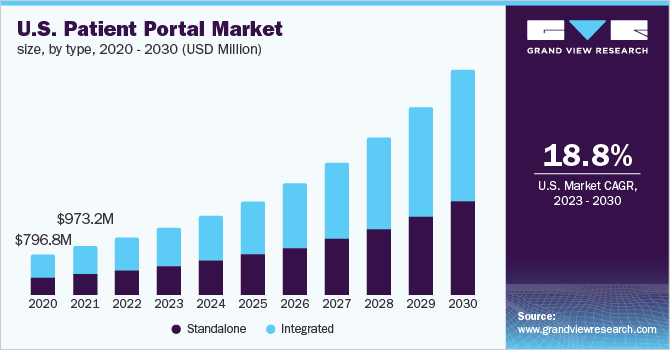
Rising demand for Electronic Health Records (EHRs) and a stronger patient-centric approach are fueling growth in the patient portal market. As healthcare digitalization accelerates, more than half of upper-middle- and high-income countries have implemented national EHR systems, according to WHO, supported by government initiatives to standardize digital health infrastructure. The U.S. market, in particular, shows strong momentum, capturing nearly a 19% growth rate driven by advanced healthcare IT adoption and patient engagement efforts*3.
Access to Engagement: The AI Shif
The next generation of patient portals is being reshaped by Artificial Intelligence (AI). Instead of simply displaying information, AI-enabled portals can*4:
- Faster responses to patient messages and queries
- Automated replies for common patient questions
- 24/7 availability for routine patient support
- Reduced waiting time for administrative requests
- More personalized responses using patient data context
- Increased patient engagement with digital health tools
- Easier access to health information and guidance
How Agastha Supports Smart Patient Portals
- Integrated EHR, billing, and clinical workflows
- AI-driven patient engagement tools
- Automated reminders and follow-ups
- Secure patient messaging and appointment scheduling
- Interoperability across hospital systems
- Real-time data insights for clinicians and administrators
Personalization: The Next Layer of Patient Engagement*5
Personalization is becoming a key feature of modern patient portals. Using patient data, health history, and behavioral insights, portals can deliver tailored reminders, preventive care recommendations, and health education content.
As healthcare continues to embrace digital transformation, patient portals will evolve into intelligent engagement platforms that connect patients, providers, and healthcare data in real time. AI-driven personalization, predictive insights, and seamless system integration will define the next generationof digital health experiences. Platforms like Agastha's multi-functional healthcare management platform are helping hospitals move beyond traditional portals toward smarter, connected, and patient-centric care ecosystems.
- *1 Proactive Chart Team(2025). Creating a Patient Portal That Patients Actually Use in 2025. Proactive Chart. Creating a Patient Portal That Patients Actually Use in 2025 - Proactive Chart
- *2 eLuminous Technologies. A Comprehensive Guide on Patient Portal Development. (Aug 29, 2025).https://eluminoustechnologies.com/blog/patient-portal-development-guide/
- *3 World Health Organization (WHO). Global Strategy on Digital Health 2020-2025. World Health Organization. Available at:https://www.who.int/publications/i/item/9789240020924
- *4Kaur A, Budko A, Liu K, Eaton E, Steitz B.D and Johnson K.B (2024). Automating Responses to Patient Portal Messages Using Generative AI. Journal of the American Medical Informatics Association (2024) https://pmc.ncbi.nlm.nih.gov/articles/PMC12310298/
- *5 Sieverink F, Schimdt K, Stock S and Redaelli M (2023). Patient Portals as Facilitators of Engagement in Patients With Diabetes and Chronic Heart Disease: Scoping Review of Usage and Usability. Journal of Medical Internet Research. https://www.jmir.org/2023/1/e38447/