

Cloud-based EHRs are now the dominant choice for healthcare practices in 2026, offering lower upfront costs, faster implementation, and easier scalability. Agastha EHR stands out positively with strong interoperability, voice recognition for documentation, and integrated practice management tools, though cloud adoption still requires careful attention to security and vendor dependence.
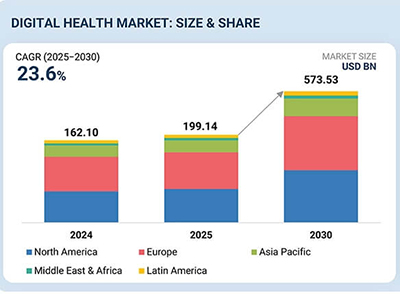
Cloud-based EHR adoption is accelerating as healthcare organizations invest in digital transformation. According to MarketsandMarkets, the global healthcare cloud computing market is expected to grow from USD 74.02 billion in 2026 to USD 169.34 billion by 2031, driven by increasing demand for scalable, secure, and interoperable healthcare solutions. As the industry shifts toward cloud-inclusive platforms, Agastha EHR is well positioned to support this evolution with its cloud-native design, integrated practice management, multi dimensional healthcare support, and interoperability, helping providers deliver efficient and connected patient care.
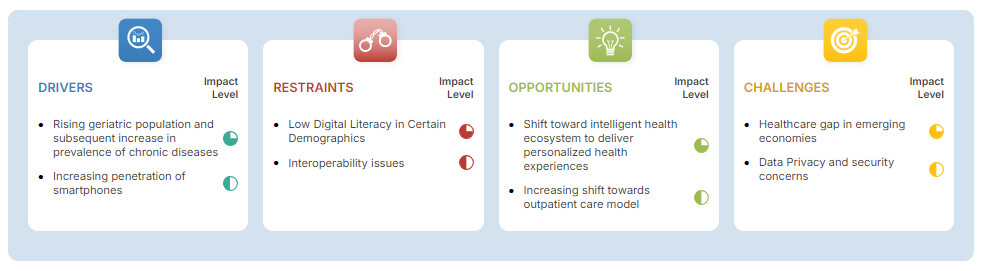
Cloud-based Electronic Health Records (EHRs) are reshaping healthcare delivery by offering flexibility, affordability, and accessibility. Yet, they also bring challenges around security, customization, and vendor dependence.*1
Cloud-based EHRs deliver flexibility, cost savings, and improved patient care by enabling secure remote access, automatic updates, and seamless collaboration across healthcare teams. They reduce IT burdens while enhancing interoperability and efficiency.
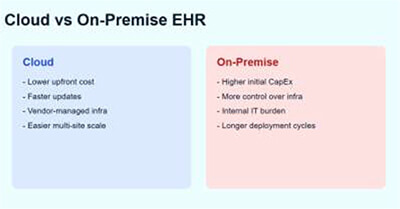
Although cloud-based EHRs dominate new purchases, there are notable drawbacks that healthcare leaders must weigh carefully. Despite accounting for roughly 80% of new EHR purchases, on-premise systems still represent 30-40% of the installed base, underscoring that many organizations remain hesitant to fully embrace the cloud. Financially, while a solo practice may spend about $58,000 over five years on cloud EHRs compared to $48,000 for on-premise, the apparent savings are misleading since the on-premise figure excludes IT labor costs, making cloud adoption potentially more expensive in the long run. Implementation timelines also pose challenges: although cloud systems average 2-4 months for small practices, on-premise deployments add 1-3 months for infrastructure setup, meaning that practices face delays and resource strain regardless of the model chosen*1.
The key benefits of cloud-based EHRs include lower upfront costs, faster implementation, built-in scalability, enhanced accessibility, and automatic updates. Agastha EHR adds strengths like voice recognition, interoperability, and integrated practice management, making it particularly valuable for small and mid-sized practices.
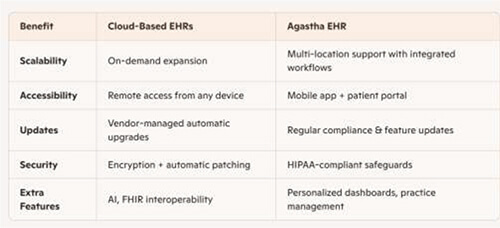
For most healthcare organizations in 2026, cloud-based EHRs provide an excellent balance of affordability, scalability, and functionality. They enable organizations to modernize operations while improving patient care through better accessibility, collaboration, and interoperability.
However, successful adoption depends on careful vendor evaluation, strong cybersecurity practices, reliable internet connectivity, and a clear understanding of long-term operational costs.
Organizations that prioritize flexibility, reduced IT maintenance, and future-ready digital healthcare capabilities are likely to benefit significantly from cloud-based EHR platforms*3.
Cloud-based EHRs have become the future of modern healthcare, offering the flexibility, scalability, and connectivity needed to support evolving clinical and administrative demands. While considerations such as data security, internet reliability, and vendor dependence remain important, the long-term benefits of improved interoperability, reduced IT overhead, and enhanced care coordination make cloud solutions a compelling choice for most healthcare providers. Backed by a growing global presence, Agastha EHR integrates cloud-native technology, practice management, multidimensional healthcare support, and interoperability to provide healthcare organizations with a scalable, future-ready platform for delivering exceptional patient care.
- *1 MarketsandMarkets (2025). Healthcare Cloud Computing Market - Global Forecast to 2031. https://www.marketsandmarkets.com/Market-Reports/cloud-computing-healthcare-market-347.html
- *2 CareExpand 2026. Cloud-Based vs. On-Premise EHR: Which Is Best for You? Retrieved from
- *3 Oracle. (2026). Understanding cloud-based EHRs: A buyer's guide. Oracle Health.https://www.oracle.com/health/cloud-based-ehrs/